1804 Draped Bust Dollar Value & Price Guide (2026)
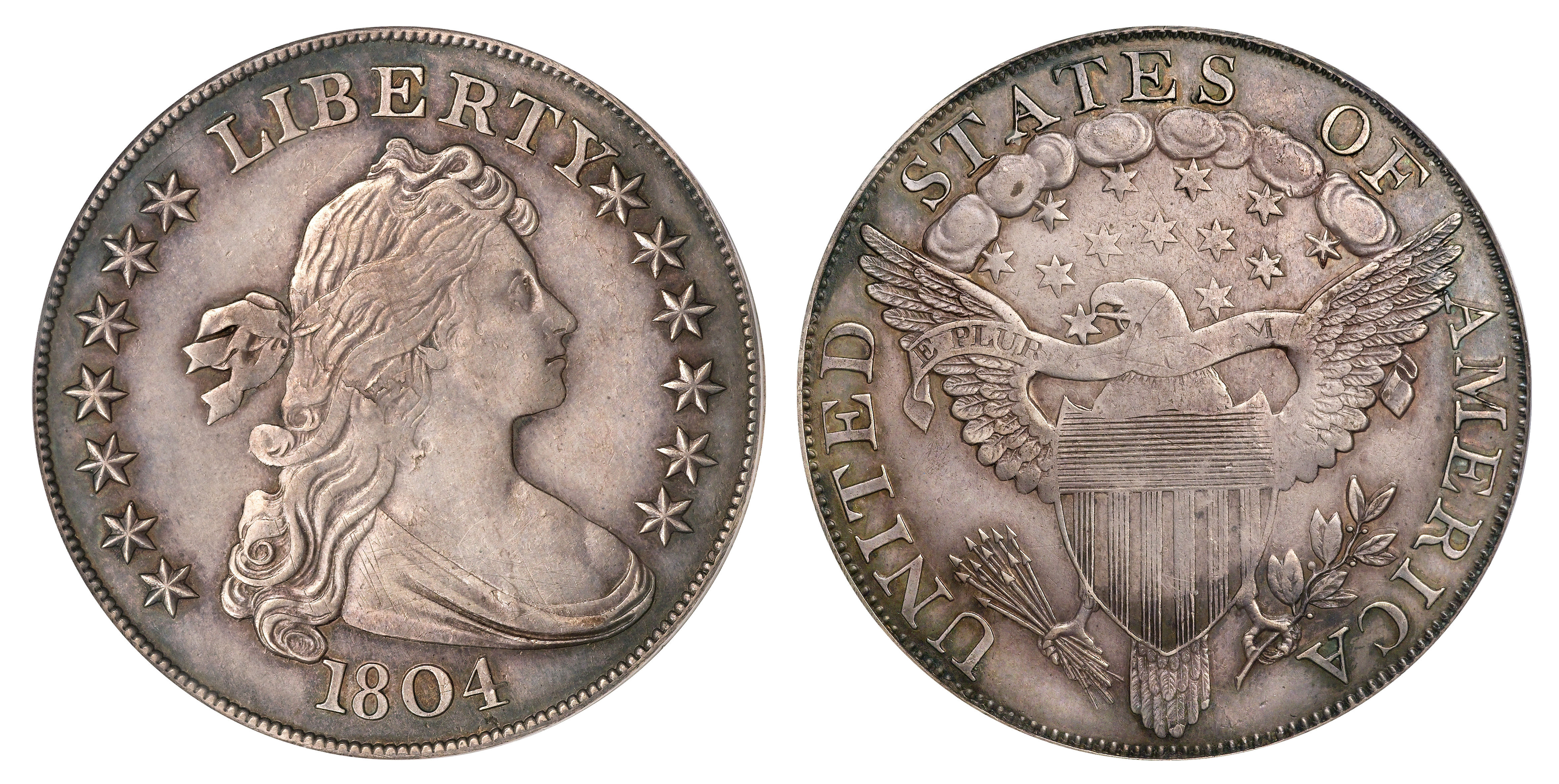
Public domain, via Wikimedia Commons
They call it the "King of American Coins." The 1804 Draped Bust dollar is one of the rarest and most famous coins in the world - and here's the twist: not a single one was actually struck in 1804. The 15 known specimens were made decades later, in the 1830s and 1850s, as diplomatic presentation pieces and collector restrikes. The most recent auction sale? $3,800,000 at Heritage Auctions in 2023.
Quick Value Summary
| Item | 1804 Draped Bust Silver Dollar |
| Year | Dated 1804 (struck 1834–1859) |
| Category | Coins - U.S. Silver Dollars |
| Composition | 89.24% silver, 10.76% copper |
| Weight | 26.96 grams |
| Diameter | 39–40mm |
| Mint | Philadelphia |
| Known Specimens | 15 (Class I: 8, Class II: 1, Class III: 6) |
| Value Range | $2,000,000 – $7,680,000 |
| Record Sale | $7,680,000 (Class I, 1999, Bowers & Merena) |
| Most Recent Sale | $3,800,000 (Heritage Auctions, August 2023) |
| Rarity | Extremely Rare |
The Story
No silver dollars were struck at the United States Mint in 1804. Production of the Draped Bust dollar had actually stopped in 1803. So how do 1804-dated dollars exist?
The answer begins in 1834, when President Andrew Jackson ordered the creation of special proof coin sets as diplomatic gifts for rulers in Asia. The State Department wanted complete sets of every U.S. denomination. The Mint looked at its records, found that dollars dated 1804 appeared in production reports (they were actually 1803-dated coins counted in the 1804 fiscal year), and struck new dollars with an 1804 date.
Eight of these were made. They're now called Class I specimens - the original diplomatic presentation pieces. They feature a heraldic eagle on the reverse, which was the design used on dollars from late 1798 onward.
Decades later, in the 1850s, Mint officials created additional specimens. A single Class II coin has a plain edge (unlike the lettered edge of Class I) and was likely a trial piece. Six Class III coins are restrikes made in 1858–1859, probably created by Mint employees for the collector market. They have the same design as Class I but show subtle die differences.
Together, 15 specimens survive. Each one is a numismatic event when it changes hands. The 1804 dollar has been called "The King of American Coins" since the 19th century, and no other U.S. coin has the same combination of rarity, history, and mystique.
The Three Classes
Class I - Original Strikes (8 known)
The original diplomatic presentation pieces, struck in 1834–1835. These are the most valuable and most famous.
Reverse: Heraldic eagle
Edge: Lettered - "HUNDRED CENTS ONE DOLLAR OR UNIT"
Notable specimens:
- Dexter/Pogue specimen - Sold for $7,680,000 in 1999
- Watters-Childs specimen - Sold for $4,140,000 in 1999
- Smithsonian Institution - Two specimens, not for sale
Class II - The Unique Plain-Edge (1 known)
A single specimen with a plain (smooth) edge instead of the lettered edge found on Class I coins. Believed to be an experimental piece or trial strike from the 1850s. Currently held by the Smithsonian Institution.
Class III - Restrikes (6 known)
Struck in 1858–1859 using a different reverse die than Class I. These were made for the collector market by Mint employees - a practice that was common (if ethically questionable) in that era.
Reverse: Shows subtle die differences from Class I
Edge: Lettered
Value: Generally lower than Class I, but still multi-million dollar coins
How to Identify It
Key Features
Obverse: Liberty facing right with flowing hair, draped bust. "LIBERTY" above, date "1804" below, stars around the rim.
Reverse: Heraldic eagle with shield, holding arrows and olive branch. "UNITED STATES OF AMERICA" around the rim.
Edge: Lettered on Class I and III. Plain on the unique Class II.
What to Check
The 1804 dollar is not a coin you're going to find in a junk box or an inherited collection. If you believe you have one:
- Be extremely skeptical. Only 15 exist. The odds of finding an unknown specimen are essentially zero.
- Check weight and composition. Should be 26.96 grams of .8924 silver.
- Look at the edge. Lettered edge reading "HUNDRED CENTS ONE DOLLAR OR UNIT."
- Contact a major auction house immediately. Heritage Auctions, Stack's Bowers, or a similar firm can arrange expert examination.
Common Fakes
Copies and reproductions of the 1804 dollar are extremely common. They've been made for over a century - as souvenirs, novelty items, and outright counterfeits. Most are obvious: wrong weight, wrong metal, wrong details. But some are sophisticated enough to require expert examination.
Authentication & Fakes
This Is the Most Important Section
If you think you have an 1804 dollar, the reality is almost certainly that you have a reproduction. Millions of copies exist. Here's how to sort it out:
Souvenir copies. The most common. Often marked "COPY" somewhere on the coin (required by the Hobby Protection Act of 1973). Made of base metal. Wrong weight, wrong feel.
Gallery Mint copies. High-quality reproductions made for educational purposes. Well-executed but not genuine.
Cast counterfeits. Poured metal copies with mushy details, incorrect edge, and often wrong weight.
Sophisticated fakes. Rare but they exist. Made from the correct silver alloy with careful attention to detail. These require expert examination - X-ray fluorescence analysis, die diagnostics, and comparison to known genuine specimens.
What to Do
If your coin is made of silver, weighs approximately 26.96 grams, and has a lettered edge - it deserves professional examination. Contact Heritage Auctions or Stack's Bowers. Do not clean it. Do not handle it more than necessary. But manage your expectations: the probability of a new genuine specimen emerging is extremely low.
Where to Sell
There's only one answer for a genuine 1804 dollar: a major auction house.
Heritage Auctions - Sold the most recent specimen for $3,800,000 in 2023
Stack's Bowers - Has handled multiple 1804 dollars over the decades
Sotheby's - For ultra-high-profile numismatic rarities
A coin at this level requires a world-class auction with international reach. The buyer pool is tiny - a handful of extremely wealthy collectors and institutions. Only the major houses can reach them.
Not sure what you have? Upload a photo to Curio Comp for a free AI estimate. Upload a photo →
Common Questions
How much is an 1804 Draped Bust dollar worth?
Millions. The most recent sale was $3,800,000 at Heritage Auctions in 2023. The all-time record is $7,680,000 for a Class I specimen in 1999. No genuine 1804 dollar has sold for less than $2 million in modern times.
Were any 1804 dollars actually made in 1804?
No. Despite the date, all known 1804 dollars were struck later - Class I specimens in 1834–1835 as diplomatic gifts, and Class II and III specimens in the 1850s.
How many 1804 dollars exist?
Fifteen known specimens across three classes: 8 Class I (original strikes), 1 Class II (unique plain edge), and 6 Class III (restrikes). Several are in museums and unlikely to be sold.
I think I have an 1804 dollar. Is it real?
Almost certainly not. Millions of copies and reproductions exist. Check for "COPY" markings, weigh it (should be 26.96g), and examine the edge lettering. If it passes basic tests, contact a major auction house for professional examination - but manage your expectations.
Why is the 1804 dollar called the "King of American Coins"?
The combination of extreme rarity (15 known), fascinating history (diplomatic gifts that weren't what they seemed), and multi-million dollar values. It's been the most prestigious U.S. coin since the 19th century.
Related Items
Have This Item?
Our AI appraisal tool is coming soon. Upload photos, get instant identification and valuation.
Get Appraisal