Song Dynasty Jun Ware Planter with Stand
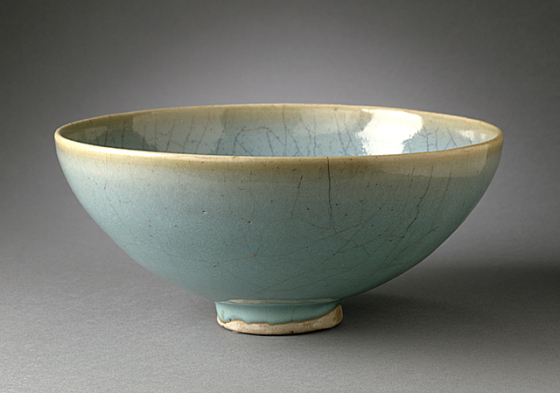
Jun ware bowl, LACMA Collection, Public Domain via Wikimedia Commons
Among the treasures of Chinese ceramics, few objects carry the weight and mystery of a Song Dynasty Jun ware planter with its matching stand. These extraordinary vessels, produced at the Jun kilns in Yuzhou, Henan province, represent the pinnacle of Chinese ceramic art. With their mesmerizing opalescent blue glazes, often streaked with dramatic splashes of purple and crimson, Jun ware planters were created for the imperial court and have been prized by collectors for nearly a thousand years. Today, authenticated examples routinely sell for millions of dollars at major auction houses.
What Makes Jun Ware Special
Jun ware (sometimes spelled Chun ware) is one of the Five Great Kilns of the Song Dynasty (960-1279 CE), alongside Ru, Guan, Ge, and Ding wares. What sets Jun ware apart from its prestigious siblings is its glaze technology. The potters at the Jun kilns developed a thick, opaque glaze that achieves its remarkable blue color not through cobalt or other blue pigments, but through a phenomenon now understood as Rayleigh scattering.
The glaze contains enormous numbers of tiny bubbles, formed by gases released during the high-temperature firing process. These microscopic bubbles scatter blue light in much the same way that Earth's atmosphere scatters sunlight to produce a blue sky. The result is a luminous, almost otherworldly blue that seems to glow from within the glaze, shifting subtly as the viewing angle changes.
The purple and crimson splashes found on many Jun pieces are created by the addition of copper oxide to the glaze. At the extreme temperatures inside the kiln (around 1,280 degrees Celsius), the copper produces vivid streaks of color that flow and blend unpredictably with the blue ground. No two pieces are identical, and the most spectacular color combinations have been treasured since the Song Dynasty itself.
The Planter and Stand Form
The planter-with-stand form is among the most distinctive and prestigious shapes in the Jun ware repertoire. These vessels were designed for growing and displaying flowers, particularly narcissus bulbs, at the imperial court. The planter sits atop a separate stand, and together they form an elegant compositional unit.
Typical planters are relatively shallow with straight or slightly flared sides, often featuring drainage holes in the base. The stands are usually lower, with a flat top surface and openwork or solid sides resting on short feet. Both pieces are fully glazed, inside and out, with the characteristic Jun blue covering every surface except the unglazed foot ring.
These forms are sometimes described in different terminology by different authors. You may see them called bulb bowls, narcissus bowls, flower pot stands, or brush washers, depending on the scholar and the era. The essential point is that these were functional objects designed for the imperial court, not merely decorative pieces.
The Numbered System
One of the most fascinating aspects of official Jun ware planters and stands is the numbering system. Many authentic pieces bear incised Chinese numerals (from one to ten) on the base, carved into the clay before glazing. This numbering system has been the subject of scholarly debate for decades.
The current consensus is that the numbers correspond to size. Number one is the largest, number ten the smallest. Matching sets of planter and stand bear the same number, ensuring proper pairing. Lower numbers (larger sizes) are generally rarer and more valuable, though all numbered Jun ware pieces are exceptionally scarce.
The numbered pieces are classified as "official" (guan) Jun ware, meaning they were produced specifically for the imperial court under strict quality controls. Imperfect pieces were destroyed at the kiln site to prevent them from entering circulation, a practice that contributes to their extraordinary rarity today.
Authentication: Genuine vs. Reproduction
Jun ware has been copied and reproduced for centuries, and distinguishing genuine Song Dynasty pieces from later reproductions requires considerable expertise. Here are the key factors experts examine:
Glaze Characteristics
Genuine Song Jun ware has a thick, viscous glaze with a distinctive "orange peel" texture on the surface. Under magnification, you should see the characteristic bubble structure within the glaze. The color should have depth and luminosity, not a flat or uniform appearance. The glaze typically thins at the rim, revealing a brownish edge (sometimes called the "iron mouth" effect).
Later reproductions, particularly those from the Ming and Qing dynasties, often have thinner, more evenly applied glazes that lack the complex bubble structure. Modern fakes may use chemical colorants instead of the traditional copper-based formulas.
Body and Foot
The stoneware body of genuine Song Jun ware is dense, heavy, and fires to a gray or grayish-brown color. The unglazed foot ring should show this body color clearly. A chalky white or light-colored body suggests a later reproduction.
The foot ring itself provides important clues. On genuine pieces, the foot is often rough and shows kiln grit or spur marks where the piece sat during firing. The glaze should stop cleanly at the foot, with a characteristic "sesame seed" pattern of small glaze droplets on the base.
Incised Numbers
On numbered pieces, the incised numerals should show evidence of having been carved into leather-hard clay before glazing. The glaze should flow into and partially fill the incised lines. Numbers that appear to have been carved after glazing, or that show sharp, crisp edges without glaze fill, are suspect.
Thermoluminescence (TL) Testing
For high-value purchases, TL testing provides a scientific method of establishing the approximate age of the ceramic body. This test measures the accumulated radiation dose in the clay, which correlates with the time since firing. While TL testing can confirm that a piece is genuinely old, it cannot distinguish between Song and Yuan/early Ming Dynasty production, as the Jun kilns operated across this period.
Market Values
Jun ware planters with stands are among the most valuable Chinese ceramics on the market. Values vary enormously based on authenticity, condition, size, color quality, and provenance.
| Category | Description | Approximate Value |
|---|---|---|
| Numbered planter with stand, Song/Yuan | Museum-quality, major auction house provenance | $2,000,000 - $15,000,000+ |
| Numbered planter only, Song/Yuan | Without original stand, excellent condition | $800,000 - $5,000,000 |
| Unnumbered Jun planter, Song/Yuan | Good glaze, authenticated | $100,000 - $800,000 |
| Jun ware bowl or dish, Song/Yuan | Simpler form, blue glaze | $20,000 - $200,000 |
| Later reproduction (Ming/Qing) | Quality period copy | $5,000 - $50,000 |
| Modern reproduction | Contemporary copy | $50 - $500 |
At a 2019 Christie's Hong Kong sale, a Yuan-Ming Dynasty "Numbered Four" Jun tripod bulb bowl carried an estimate of HK$12-15 million (approximately $1.5-1.9 million USD). These figures reflect the extraordinary rarity of authenticated examples.
Condition Considerations
Unlike many collectible categories where mint condition is the standard, Chinese ceramics from the Song Dynasty are evaluated with an understanding that these objects are nearly a thousand years old. Some condition issues are considered acceptable or even expected:
Minor chips to the foot ring: Common and usually not a significant detractor
Hairline cracks: Can be acceptable if stable, though they reduce value
Kiln flaws: Original firing defects (pinholes, crawling glaze) are part of the character and do not reduce value
Wear to the glaze surface: Some surface wear is expected and helps confirm age
Repairs: Significant repairs dramatically reduce value but may be acceptable in very rare pieces
Missing stand: Many planters have become separated from their stands over the centuries. A planter without its matching stand is less valuable but still highly collectible
What to Look for When Buying
Provenance is paramount. For objects in this value range, documented ownership history going back decades (ideally to a known collection formed before the 1990s) provides crucial assurance. The Chinese antiquities market has seen a flood of forgeries since the 1990s.
Buy from major auction houses or established dealers. Christie's, Sotheby's, and specialist dealers in Chinese ceramics provide expertise and guarantees that the secondary market cannot match.
Request TL testing. For any significant purchase, thermoluminescence testing should be conducted by a reputable laboratory.
Examine the glaze under magnification. Bring a good loupe (10x-20x) and look for the bubble structure, orange peel texture, and proper color depth.
Study museum collections first. Before spending serious money, visit museum collections with Jun ware holdings. The Harvard Art Museums, National Palace Museum (Taipei), Palace Museum (Beijing), and the Percival David Foundation collection at the British Museum all have important Jun ware holdings. Familiarize yourself with how genuine pieces look and feel.
Understand the dating debate. Scholars continue to debate whether numbered Jun ware was produced during the Song Dynasty or somewhat later, during the Yuan or early Ming period. This debate affects attribution but has not significantly impacted market values, as pieces from any of these periods are exceptionally rare and desirable.
Budget for expertise. Factor in the cost of TL testing, expert consultation, and possibly academic research when planning a major purchase. These costs are trivial compared to the investment and can save you from a catastrophic mistake.
The Scholarly Debate
It is worth noting that the dating of numbered Jun ware remains one of the most active debates in Chinese ceramic studies. Traditional scholarship attributed these pieces to the Northern Song Dynasty, but archaeological evidence from kiln site excavations in the 1990s and 2000s has led some scholars to propose a later date, possibly Yuan Dynasty (1271-1368) or even early Ming Dynasty (1368-1644).
The Harvard Art Museums have conducted extensive scientific analysis of their Jun ware collection, using techniques including X-ray fluorescence, petrographic analysis, and the study of glaze bubble structures. Their research has contributed significantly to our understanding of how these remarkable glazes were produced.
Regardless of the exact dating, the quality, beauty, and historical significance of these pieces are beyond question. A Jun ware planter with stand, whether Song or Yuan, represents one of the supreme achievements of the Chinese ceramic tradition.
Related Items
Have This Item?
Our AI appraisal tool is coming soon. Upload photos, get instant identification and valuation.
Get Appraisal